Bonjour Allison, et bravo pour cet excellent exemple d'utilisation de l'expression du jour 🤩🤩🤩
Merci encore de votre participation !

Have you heard of “idiomatic expressions”? These are figurative expressions specific to French, that are usually not translatable directly, as each language uses its own references! Therefore, you need to learn them directly in the language, as well as learning French equivalents to the ones you use in English! Knowing idiomatic expressions is key when learning a new language and it will definitely help you sound like a true Français 😊
Want to learn more about this fun expression, what it means, and hear some in-context examples? Then listen to Aurélie and Céline‘s related podcast below:
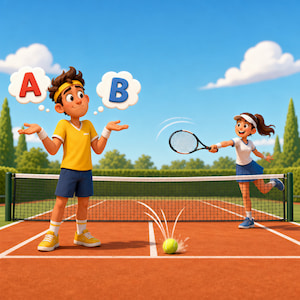
The expression “La balle est dans ton camp” is a sporting metaphor which is borrowed from ball games played across two sides of a court, such as tennis. It’s used to tell someone that they now have the initiative to act or make a decision, i.e. the responsibility (“ball”) has been passed on to them.
To help you commit this expression to memory, here are some useful examples of how to use it in context:
With this great Fill-in-the-Blanks exercise featuring our new expression, you get to practise your French grammar while getting another in-context use of the expression “la balle est dans ton camp” to help you remember it 🤗 Que demander de plus ?
Challenge yourself to use this expression in a French conversation or piece of writing, and let us know what you thought of this expression, share your idiomatic sentences, and tell us how your French friends reacted to it – en français bien sûr – in the comments below ☺️
À toi de jouer !
For over ten years now, Céline has been teaching French and Italian to students of all ages and abilities in the UK. This French native speaker comes from Brittany, and likes crafts, Breton dance (of course!) and Breton music which she actually played for four years. She also has a fondness for European cinema and British History.

Aurélie is our resident French Expert. She has created most of the wonderful content you see on the site and is usually the person answering your tricky help questions. She comes from a small village near Chartres in Central France, country of cereal fields and not much else. She left (in a hurry) to study English at the world-famous Sorbonne in Paris, before leaving France in 2007 to experience the “London lifestyle” - and never looked back! She's worked as a professional French teacher, translator and linguist in the UK since. She loves to share her love of languages and is a self-professed cinema and literature geek!

Bonjour Allison, et bravo pour cet excellent exemple d'utilisation de l'expression du jour 🤩🤩🤩
Merci encore de votre participation !
These girls have such shrill voices. They are too expressive, people do not speak like them with so much hysteria. They laugh too much trying to project what a great time they are having. I am trying to learn and all those Ahhs and Umms and oos are so distracting. I love the quizzes and lessons these girls, I avoid.
Bonjour Cassandra, et merci d'avoir partagé votre opinion avec nous !
Tout d'abord, Céline et moi sommes ravies que vous appréciiez autant les leçons et les quizz que nous créons pour nos Kwizzers bien-aimés 😊
En ce qui concerne nos podcasts, je peux simplement vous assurer que notre enthousiasme est tout à fait authentique, car Céline et moi prenons un réel plaisir à enregistrer ces conversations pédagogiques dans la bonne humeur 😉
N'hésitez pas à nous partager vos exemples d'utilisation des expressions idiomatiques de notre série "À la française" (même sans avoir écouté le podcast!) 😊
Merci pour votre gentil commentaire Neil, c'est exactement le but de ces podcasts, nous sommes ravies que cela vous plaise 😊
Merci beaucoup Pindiwe !
Céline et moi sommes ravies que ces podcasts vous plaisent. Nous adorons les faire aussi 😄
La directrice de la chorale ne peut prendre de décision concernant la date du concert tant que les responsables de la salle ne l’ont pas informée de leurs disponibilités. La balle est dans leur camp.